Biography of a Founding Father and Relative: Richard Stockton

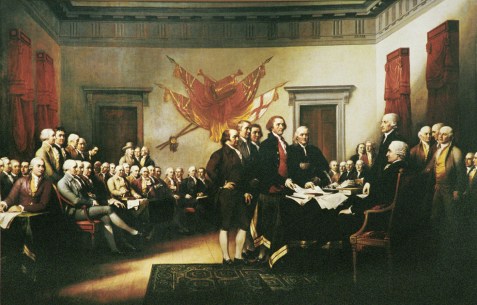
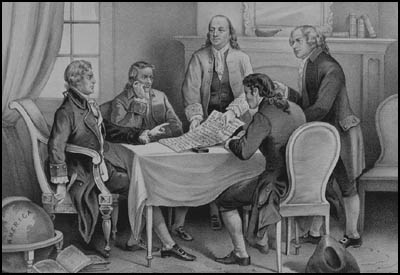
Statesmen with Declaration of Independence

http://colonialhall.com/biodoi.php

The following biographical sketches of America’s founding fathers are taken from the 1829 book, Lives of the Signers to the Declaration of Independence, by the Rev. Charles A. Goodrich.

July 4th

The Signers of the Declaration of Independence

Massachusetts
John Hancock
Samuel Adams
John Adams
Robert Treat Paine
Elbridge Gerry

New Hampshire
Josiah Bartlett
William Whipple
Matthew Thornton

Rhode Island
Stephen Hopkins
William Ellery

Connecticut
Roger Sherman
Samuel Huntington
William Williams
Oliver Wolcott

New York
William Floyd
Philip Livingston
Francis Lewis
Lewis Morris

New Jersey
Richard Stockton
John Witherspoon
Francis Hopkinson
John Hart
Abraham Clark

Pennsylvania
Robert Morris
Benjamin Rush
Benjamin Franklin
John Morton
George Clymer
James Smith
George Taylor
James Wilson
George Ross

Delaware
Caesar Rodney
George Read
Thomas M’ Kean

Maryland
Samuel Chase
William Paca
Thomas Stone
Charles Carrol

Virginia
George Wythe
Richard Henry Lee
Thomas Jefferson
Benjamin Harrison
Thomas Nelson, Jr.
Francis Lightfoot Lee
Carter Braxton

North Carolina
William Hooper
Joseph Hewes
John Penn

South Carolina
Edward Rutledge
Thomas Heyward
Thomas Lynch
Arthur Middleton

Georgia
Button Gwinnett
Lyman Hall
George Walton

trumbull-large

Family history tells us that we are related to Richard Stockton, one of the signers of the Declaration of Independence, one the the greatest documents of our Nation. Here is some very interesting information on one of our own.  Notice in the post on his wife (that follows this post):  as a poet, she has addressed a poem to a “Mary Stockton!”
richard_stockton

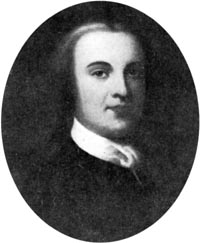
Richard Stockton

1730-1781

Richard Stockton
Richard Stockton: From the National Statuary Hall Collection at the U.S. Capitol

The first of the New-Jersey delegation, who signed the Declaration of Independence, was Richard Stockton. He was born near Princeton, on the 1st day of October, 1730. His family was ancient and respectable. His great grandfather, who bore the same name, came from England, about the year 1670, and after residing a few years on Long Island, removed with a number of associates to an extensive tract of land, of which the present village of Princeton is nearly the center. This tract consisted of six thousand and four hundred acres. This gentleman died in the year 1705, leaving handsome legacies to his several children; but the chief portion of his landed estate to his son, Richard. The death of Richard followed in 1720. He was succeeded in the family seat by his youngest son, John; a man distinguished for his moral and religious character, for his liberality to the college of New-Jersey, and for great fidelity in the discharge of the duties of public and private life.

Richard Stockton, the subject of the present memoir, was the eldest son of the last mentioned gentleman. His early education was highly respectable, being superintended by that accomplished scholar, Rev. Dr. Samuel Finley, in a celebrated academy at West-Nottingham. His preliminary studies being finished, he entered the college of New-Jersey, whose honors he received in 1748. He was even at this time greatly distinguished for intellectual superiority; giving promise of future eminence in any profession he might choose.

On leaving college, he commenced the study of law with the honorable David Ogden, of Newark, at that time at the head of the legal profession in the province. At length, Mr. Stockton was admitted to the bar, and soon rose, as had been anticipated, to great distinction, both as a counselor and an advocate. He was an able reasoner, and equally distinguished for an easy, and, at the same time, impressive eloquence.

In 1766 and 1767, he relinquished his professional business, for the purpose of visiting England, Scotland, and Ireland. During his tour through those countries, he was received with that attention to which he was eminently entitled, by the estimable character which he had sustained at home, and his high professional reputation. He was presented at court, by administer of the king, and had the honor of being consulted on American affairs, by the Marquis of Rockingham, by the Earl of Chatham, and many other distinguished personages.

On visiting Edinburgh, he was received with still greater attention. He was complimented with a public dinner, by the authorities of that city, the freedom of which was unanimously conferred upon him, as a testimony of respect for his distinguished character.

A short time previous, the presidency of New-Jersey college had been conferred upon the Reverend Dr. Witherspoon, a distinguished divine, of the town of Paisley, in the vicinity of Glasgow. This appointment Dr. Witherspoon had been induced to decline, by reason of the reluctance of the female members of his family to emigrate to America. At the request of the trustees of the College, Mr. Stockton visited Dr. Witherspoon, and was so fortunate in removing objections, that not long after the latter gentleman accepted the appointment, and removed to America, where he became a distinguished supporter of the college over which he presided, a friend to religion and science in the country, and one of the strong pillars in the temple of American freedom.

The following instances in which Mr. Stockton narrowly escaped death,. during his absence, deserve notice. While he was in the city of Edinburgh, he was waylaid one night by a furious robber. He defended himself, however, by means of a small sword, and even succeeded in wounding the desperado. He was not materially injured himself, but was not so fortunate as to prevent the escape of his assailant. In the other case, he was designing to cross the Irish channel, and had actually engaged a passage in a packet for that purpose. The unseasonable arrival of his baggage, however, detained him, and fortunate it was that he was thus detained, for the packet, on her voyage, was shipwrecked during a storm, and both passengers and crew found a watery grave.

The following year he was appointed one of the royal .In judges of the province, and a member of the executive council. At that time he was high in the royal favor, and his domestic felicity seemed without alloy. He possessed an ample fortune, was surrounded by a family whom he greatly loved, and held a high and honorable station under the king of Great Britain.

But the time at length arrived, when the question arose, whether he should renounce his allegiance to his sovereign, and encounter the sacrifices which such a step must bring upon him, or continue that allegiance, and forfeit his character as a friend to his country.

Situated as was Mr. Stockton, the above question could not long remain unsettled; nor was it for any length of time doubtful into which scale he would throw the weight of his influence and character. The sacrifices which he was called upon to make, were cheerfully endured. He separated himself from the, royal council, of which be was a member in New-Jersey, and joyfully concurred in all those measures of the day, which had for their object the establishment of American rights, in opposition to the arbitrary and oppressive acts of the British ministry.

On the twenty-first of June, 1776, he was elected by the provincial congress of New-Jersey a delegate to the general congress, then sitting in the city of Philadelphia. On the occurrence of the question relating to a declaration of independence, it is understood that he had some doubts as to the expediency of the measure. These doubts, however, were soon dissipated by the powerful and impressive eloquence of John Adams, the great Colossus on this subject on the floor of congress. Mr. Stockton was not only convinced of the importance of the measure, but even addressed the house in its behalf, before the close of the debate. It is needless to detain the reader by a particular mention of the many important services which Mr. Stockton rendered his country, while a member of congress. In all the duties assigned to him, which were numerous and often arduous, he acted with an energy and fidelity alike honorable to him as a man and a patriot.
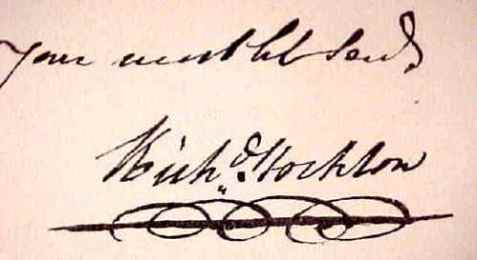
richard-stockton_signature

On the thirtieth of November he was unfortunately taken prisoner by a party of refugee royalists. He was dragged from his bed by night, and carried to New-York. During his removal to the latter place he was treated with great indignity, and in New-York he was placed in the common prison, where he was in want of even the necessaries of life. The news of his capture and sufferings being made known to congress, that body unanimously passed the following resolution:

“Whereas congress hath received information that the Honorable Richard Stockton, of New-Jersey, and a member of this congress, hath been made a prisoner by the enemy, and that he hath been ignominiously thrown into a common goal, and there detained-Resolved, that General Washington be directed to make immediate inquiry into the truth of this report, and if he finds reason to believe it well founded, that he send a flag to General Howe, remonstrating against this departure from that humane procedure which has marked the conduct of these states to prisoners who have fallen into their hands; and to know of General Howe whether he chooses this shall be the future rule for treating all such, on both sides, as the fortune of war may place in the hands of either party.”

Mr. Stockton was at length released; but his confinement had been so strict, and his sufferings so severe, that his constitution could never after recover the shock. Besides this, his fortune, which had been ample, was now greatly reduced. His lands were devastated; his papers and library were burnt; his implements of husbandry destroyed; and his stock seized and driven away. He was now obliged to depend, for a season, upon the assistance of friends, for even the necessaries of life. From the time of his imprisonment his health began to fail him; nor was it particularly benefited by his release, and a restoration to the society of his friends. He continued to languish for several years, and at length died at his residence, at Princeton, on the 28th of February, 1781, in the fifty-third year of his age.

His death made a wide chasm among the circle of his friends and acquaintance. He was, in every respect, a distinguished man ; an honor to his country, and a friend to the cause of science, freedom, and religion, throughout the world. The following extract from the discourse delivered on the occasion of his interment, by the Rev. Dr. Samuel S. Smith, will convey to the reader a just account of this distinguished man:

“Behold, my brethren, before your eyes, a most sensible and affecting picture of the transitory nature of mortal things, in the remains of a man who hath been long among the foremost of his country for power, for wisdom, and for fortune; whose eloquence only wanted a theatre like Athens, to have rivaled the Greek and the Roman fame; and who, if what honors this young country can bestow, if many and great personal talents, could save man from the grave, would not thus have been lamented here by you. Behold there ‘the end of all perfection.’

“Young gentlemen, (the students of the college,) another of the fathers of learning and eloquence is gone. He went before in the same path in which you are now treading, and hath since long presided over, and helped to confirm the footsteps of those who were here laboring up the hill of science and virtue. While you feel and deplore his loss as a guardian of your studies, and as a model upon which you might form yourselves for public life, let the memory of what he was excite you to emulate his fame; let the sight of what he is, teach you that every thing human is marked with imperfection.

“At the bar he practiced for many years with unrivaled reputation and success. Strictly upright in his profession, be scorned to defend a cause that he knew to be unjust. A friend to peace and to the happiness of mankind, be has often with great pains and attention reconciled contending parties, while he might fairly, by the rules of his profession, have drawn from their litigation no inconsiderable profit to himself. Compassionate to the injured and distressed, he hath often protected the poor and helpless widow unrighteously robbed of her dower, hath heard her with patience, when many wealthier clients were waiting, and hath zealously promoted her interest, without the prospect of reward, unless he could prevail to have right done to her, and to provide her an easy competence for the rest of her days.

“Early in his life, his merits recommended him to his prince and to his country, under the late constitution, who called him to the first honors and trusts of the government. In council be was wise and firm, but always prudent and moderate. Of this be gave a public and conspicuous instance, almost under your own observation, when a dangerous insurrection in a neighboring county had driven the attorneys from the bar, and seemed to set the laws at defiance. Whilst all men were divided betwixt rash and timid counsels, he only, with wisdom and firmness, seized the prudent mean, appeased the rioters, punished the ringleaders, and restored the laws to their regular course.

“The office of a judge of the province, was never filled with more integrity and learning than it was by him, for several years before the revolution. Since that period, he hath represented New-Jersey in the congress of the United States. But a declining health, and a constitution worn out with application and with service, obliged him, shortly after, to retire from the line of public duty, and hath at length dismissed him from the world.

“In his private life, he was easy and graceful in his manners; in his conversation, affable and entertaining, and master of a smooth and elegant style even in his ordinary discourse. As a man of letters, be possessed a superior genius, highly cultivated by long and assiduous application. His researches into the principles of morals and religion were deep and accurate, and his knowledge of the laws of his country extensive and profound. He was well acquainted with all the branches of polite learning; but he was particularly admired for a flowing and persuasive eloquence, by which lie long governed in the courts of justice.

“As a Christian, you know that, many years a member of this church, he was not ashamed of the gospel of Christ. Nor could the ridicule of licentious wits, nor the example of vice in power, tempt him to disguise the profession of it, or to decline from the practice of its virtues. He was, however, liberal in his religious principles. Sensible, as became a philosopher, of the rights of private judgment, and of the difference in opinion that must necessarily arise from the variety of human intellects; he was candid, as became a Christian, to those who differed from him, where he observed their practice marked with virtue and piety. But if we follow him to the last scene of his life, and consider him under that severe and tedious disorder which put a period to it, there the sincerity of his piety, and the force of religion to support the mind in the most terrible conflicts, was chiefly visible. For nearly two years be bore with the utmost constancy and patience, a disorder that makes us tremble only to think of it. With most exquisite pain it preyed upon him, until it reached the passages by which life is sustained: yet, in the midst of as much as human nature could endure, he always discovered a submission to the will of heaven, and a resignation to his fate, that could only flow from the expectation of a better life.

“Such was the man, whose remains now lie before us, to teach us the most interesting lessons that mortals have to learn, the vanity of human things; the importance of eternity; the holiness of the divine law; the value of religion; and the certainty and rapid approach of death.”
committee

Marker in Cemetery of the

Quaker Church, Princeton, NJ

Marker in Cemetery of Quaker Church, Princeton, NJ by Ken Kuhl.
Grave marker of Richard Stockton, a signer of the Declaration of Independence in the cemetery of  the Princeton Society of Friends (aka Quakers) church built in 1726.
Quaker Church, Princeton, NJ by Ken Kuhl.Cemetery of the Princeton Society of Friends (aka Quakers) church built in 1726.
Cemetery of Quaker Church, Princeton, NJ by Ken Kuhl.Cemetery of the Princeton Society of Friends (aka Quakers) church built in 1726.

https://i0.wp.com/www.presidentialgraves.com/images/192.jpg

See also:

The biography of Annis Boudinot Stockton, Richard Stockton’s wife

The Religious Affiliation of Richard Stockton

Source: Rev. Charles A. Goodrich Lives of the Signers to the Declaration of Independence. New York: William Reed & Co., 1856. Pages 204-211. (Some minor spelling changes may have been made.)

Wikipedia on Richard Stockton

WHAT HAPPENED TO THEM?

Have you ever wondered what happened to the 56 men who signed the Declaration of Independence?

NOTE:  If you have ever received an e-mail describing what really happened to the signers of the Declaration of Independence that describes their many tales of woe, don’t believe it! The “how the signers suffered” or “the price they paid” spiel contains numerous errors. (SOURCES: Click here for the full story that debunks the Internet e-mail hoax. Need more proof?  Click here.)

For the record, here’s a portrait of the men who pledged “our lives, our fortunes and our sacred honor” for liberty many years ago.

Note:  Snopes on Richard Stockton

Richard Stockton of New Jersey was the only signer taken prisoner specifically because of his status as a signatory to the Declaration, “dragged from his bed by night” by local Tories after he had evacuated his family from New Jersey, and imprisoned in New York City’s infamous Provost Jail like a common criminal. However, Stockton was also the only one of the fifty-six signers who violated the pledge to support the Declaration of Independence and each other with “our Lives, our Fortunes, and our sacred Honor,” securing a pardon and his release from imprisonment by recanting his signature on the Declaration and signing an oath swearing his allegiance to George III.

Fifty-six men from each of the original 13 colonies signed the Declaration of Independence on July 4, 1776. Nine of the signers were immigrants, two were brothers and two were cousins. One was an orphan. The average age of a signer was 45. Benjamin Franklin was the oldest delegate at 70. The youngest was Thomas Lynch Jr. of South Carolina at 27.

Eighteen of the signers were merchants or businessmen, 14 were farmers, and four were doctors. Twenty-two were lawyers – although William Hooper of North Carolina was “disbarred” when he spoke out against the king – and nine were judges. Stephen Hopkins had been governor of Rhode Island. Forty-two signers had served in their colonial legislatures.

John Witherspoon of New Jersey was the only active clergyman to attend. (Indeed, he wore his pontificals to the sessions.) Almost all were Protestants. Charles Carroll of Maryland was the lone Roman Catholic.

Seven of the signers were educated at Harvard, four at Yale, four at William & Mary, and three at Princeton. Witherspoon was the president of Princeton, and George Wythe was a professor at William & Mary. His students included Declaration scribe Thomas Jefferson.

Seventeen signers fought in the American Revolution. Thomas Nelson was a colonel in the Second Virginia Regiment and then commanded Virginia military forces at the Battle of Yorktown. William Whipple served with the New Hampshire militia and was a commanding officer in the decisive Saratoga campaign. Oliver Wolcott led the Connecticut regiments sent for the defense of New York and commanded a brigade of militia that took part in the defeat of General Burgoyne. Caesar Rodney was a major general in the Delaware militia; John Hancock held the same rank in the Massachusetts militia.

The British captured five signers during the war. Edward Rutledge, Thomas Heyward, and Arthur Middleton were captured at the Battle of Charleston in 1780. George Walton was wounded and captured at the Battle of Savannah. Richard Stockton of New Jersey never recovered from his incarceration at the hands of British Loyalists. He died in 1781.

Thomas McKean of Delaware wrote John Adams that he was “hunted like a fox by the enemy – compelled to remove my family five times in a few months.” Abraham Clark of New Jersey had two of his sons captured by the British during the war.

Eleven signers had their homes and property destroyed. Francis Lewis’s New York home was razed and his wife taken prisoner. John Hart’s farm and mills were destroyed when the British invaded New Jersey, and he died while fleeing capture. Carter Braxton and Nelson, both of Virginia, lent large sums of their personal fortunes to support the war effort but were never repaid.

Fifteen of the signers participated in their states’ constitutional conventions, and six – Roger Sherman, Robert Morris, Franklin, George Clymer, James Wilson, and George Reed – signed the U.S. Constitution.

After the Revolution, 13 signers went on to become governors. Eighteen served in their state legislatures. Sixteen became state and federal judges. Seven became members of the U.S. House of Representatives. Six became U.S. senators. James Wilson and Samuel Chase became Supreme Court justices. Jefferson, Adams, and Elbridge Gerry each became vice president. Adams and Jefferson later became president.

Five signers played major roles in the establishment of colleges and universities: Franklin and the University of Pennsylvania; Jefferson and the University of Virginia; Benjamin Rush and Dickinson College; Lewis Morris and New York University; and George Walton and the University of Georgia.

Adams, Jefferson, and Carroll were the longest surviving signers. Adams and Jefferson both died on July 4, 1826, the 50th anniversary of the Declaration of Independence. Carroll was the last signer to die in 1832 at the age of 95.

Sources: Robert Lincoln, Lives of the Presidents of the United States, with Biographical Notices of the Signers of the Declaration of Independence (Brattleboro Typographical Company, 1839); John and Katherine Bakeless, Signers of the Declaration (Boston: Houghton Mifflin, 1969); Biographical Directory of the United States Congress, 1774-1989 (Washington, D.C.: U.S. Government Printing Office, 1989).
Herman Classics

sun-bathing

Blessing

¸…¸    __/ /\____ ____
,·´º o`·, /__/ _/\_ //____/\
“`)¨(´´´ | | | | | | | || |l±±±± |

¸,.-·-°´ ¸,.-·~·~·-.,¸ `°~·-. :º°
…but as for me and my house, we will serve the Lord.

Joshua 24:15

A Nostalgic Test: Just for Fun

This is a test for all us ‘big kids!

The answers are below (don’t cheat).


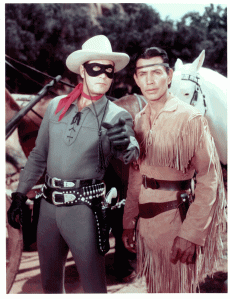
lone-ranger-and-tonto

01. After the Lone Ranger saved the

day and rode off into the sunset, the

grateful citizens would ask, “Who was

that masked man?” Invariably, some-

one would answer, I don’t know, but

he left this behind. What did he

leave behind? ___________________


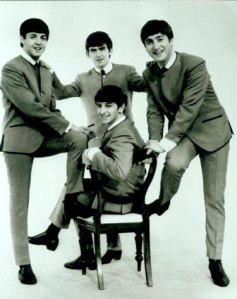
beatles1963


02. When the Beatles first came to

the U.S, in early 1964, we all watched

them on ‘The_______________Show.’


03.
‘Get your kicks, ______________.’


04.
‘The story you are about to see is

true.  The names have been changed

to _____________________.’


05.
‘In the jungle, the mighty jungle,

________________________.’


06
. After the Twist, The Mashed Potato,

and the Watusi, we ‘danced’ under a

stick that was lowered as low as we

could go in a dance called the _______ .’


twist


07. Nestle’s makes the very best _____.


08.
Satchmo was  America ‘s

‘Ambassador of Goodwill.’ Our parents

shared this great jazz trumpet player with

us. His name was ___________________.


09.
What takes a licking and keeps on

ticking?   _______________________.


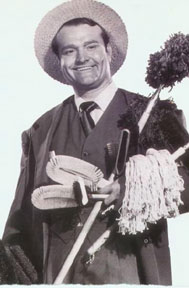
fuller-brush-man


10
. Red Skeleton’s hobo character was

named ______________________ and Red

always ended his television show by

saying,’Good Night, and____________.’


vietnam-pic

11.
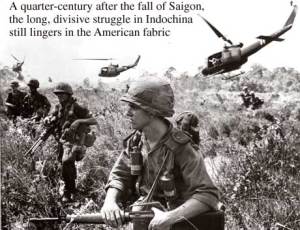
Some Americans who protested the

Vietnam  War did so by burning their

__________________.


12.
The cute little car with the engine

in the back and the trunk in the front

was called the VW. What other names

did it go by? _________ & _________.

don-maclean

13.
In 1971, singer Don MacLean sang

a song about, ‘the day the music died.’

This was a tribute to ______________.


14.
We can remember the first satellite

placed into orbit. The Russians did it.

It was called __________________.


15. One of the big fads of the late 50’s

and 60’s was a large plastic ring that

we twirled around our waist. It was

called the  ______________________.

.

.

.

.

ANSWERS :


01. The Lone Ranger left behind a

silver bullet.


02.
The Ed Sullivan Show


03. On Route 66


04. To protect the innocent
.


05. The Lion Sleeps Tonight


06. The limbo


07. Chocolate


08. Louis Armstrong


09. The Timex watch


10. Freddy, The
Freeloader and

‘Good Night and God Bless.’


11. Draft cards (Bras were also

burned.  Not flags, as some

have guessed)


12. Beetle or Bug


13. Buddy Holly


14. Sputnik


15. Hula-hoop

cheryl_lee_driveway59

                Lee and Cheryl

Riding the Train

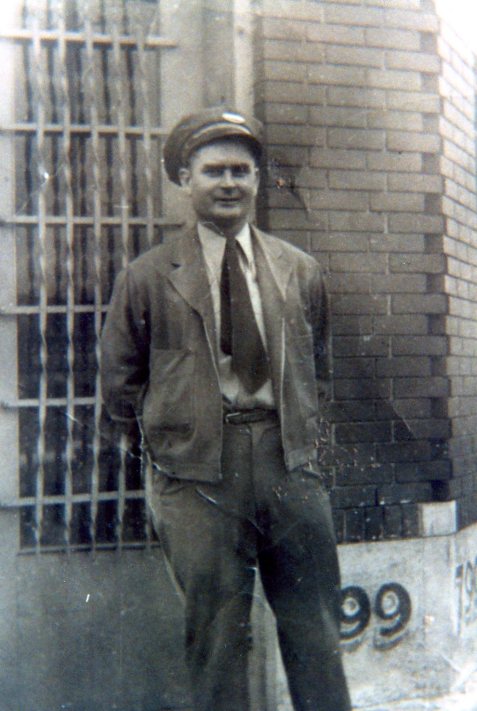
Daddy was a hard worker.  For about a dollar a day, Nathan Wright, worked as a “Watchman” for the Southern Railroad to support his large family.  For 30 years he went to work for the railroad.

watchman_watch-stationPhoto of a Railroad Watchman and crossing watchman shack (Unidentified Man)

There was a benefit to daddy working for the railroad.  The entire family was able to ride the train for free, mostly traveling to visit relatives.  They were able to ride as often as they wanted.   It was a lot of fun.  But then, the Wrights always had fun no matter what they did.

conductors-lantern

Buntyn Station was a suburban Southern station located at Southern Avenue and Semmes Street. The view below shows Buntyn Station, Circa 1949, looking west, SRR Forrest Yard and coal chute in distance (coal chute demolished 1950), Crossing watchman shack on left, Memphis Country Club entrance on right.

southern_buntyn-station-21Buntyn Station, Memphis, TN  (Photo property of Bill Strong)

Southern Railroad (Presently Norfolk Southern), the Southern Railway, forever remembered by its famous slogan, “The Southern Serves the South – Look Ahead, Look South” (it was also known for the slogan “The Southern Gives a Green Light To Innovation”), was created from a number of smaller railroads, which merged over the years to form the Southern Railway. Perhaps the railroad’s famous green paint scheme was fitting for the railroad as it became the most respected and arguably the best managed railroad of its day before it disappeared into a merger with the Norfolk & Western Railway (N&W) in 1982 to form today’s Norfolk Southern Railway (NS).

ssw_logo

The modern Southern Railway system was formed in 1894 when the Richmond & Danville and East Tennessee, Virginia & Georgia railroads merged. After this initial merger the new Southern Railway began to grow through consolidations with other smaller railroads. During the Southern Railway’s final form the railroad stretched from Richmond to Florida and west to Memphis and New Orleans and would be made up of some 125 smaller railroads. The Southern Railway’s most important main line stretched from Atlanta to Washington, D.C. and was entirely double-tracked.

On July 1, 1894, the East Tennessee, Virginia, and Georgia Railroad merged with the Richmond and Danville Railroad to form the new Southern Railway. Southern later acquired many more companies and within a decade was one of the most extensive railway systems in the nation. Of the three railway companies serving Johnson City, the Southern was the largest and offered more connections. At full build out the Southern, Clinchfield, and ET & WNC lines brought a combined 20 passenger trains daily into Johnson City. As the railroads brought prosperity to East Tennessee, the areas largest cities – Johnson City and Bristol – became rivals of sorts for new industry and business from the Southern Railway and other smaller railway lines.

Southern Railway suspended passenger service to Johnson City in 1970 and the brick depot originally constructed in 1912 was dismantled in 1973. The main line of the Northfolk Southern Railway presently operates along the original route of the East Tennessee and Virginia Railroad through downtown Johnson City and westward to Jonesborough and Knoxville.

southern-engine
Sid Davies Photo, Louis A. Marre Collection

Southern Railway Forrest Yard

Southern Railway Improvements at Memphis Railway Age Gazette, June 19, 1914, page 1554

Southern Railway has begun construction of a large classification yard and engine terminal at Buntyn, six miles east of Memphis, and the contract for grading the grounds has been let to C.W. Lane & Co., of Atlanta, GA. The new terminal will be named Forrest. Two groups of tracks will be laid, a receiving yard and a distributing yard, with an aggregate length of track of about 15 miles. The eastbound classification yard and the westbound receiving yard will have 12 tracks with a capacity of 60-65 cars each, while the eastbound receiving and the westbound classification yards will be of about the same extent. The roundhouse will have 18 stalls and a 90-foot turntable, to be worked by power. The coal plant will be of reinforced concrete and have a capacity of 1,000 tons. There will be a small machine shop and a shed for freight car repairs. A two-story office building and a track scale of large capacity will complete the plant.

southern_buntyn-mps-10-14-491(Property of Bill Busler, one of the kids in the photo)

southern_arrival_departure-board1Southern Railway Train Arrival and Departure Bulletin

unionstathroatUnion Station

southern_head-end_no461Southern Railroad Head End #46

Southern Railway is the product of nearly 150 predecessor lines that were combined, reorganized and recombined since the 1830s.

The nine-mile South Carolina Canal & Rail Road Co., Southern’s earliest predecessor line, was chartered in December 1827 and ran the nation’s first scheduled passenger service to be pulled regularly by a steam locomotive — the wood-burning “Best Friend of Charleston” — out of Charleston, S.C., on Christmas Day 1830. When its 136-mile line to Hamburg, S.C. was completed in October 1833, it was the longest continuous line of railroad in the world.

As railroad fever struck other Southern states, networks gradually spread across the South and even across the Allegheny Mountains. Charleston and Memphis, Tenn., were linked by 1857, although rail expansion halted with the start of the Civil War.

Known as the “first railroad war,” the Civil War left the South’s railroads and economy devastated. Most of the railroads, however, were repaired, reorganized and operated again. In the area along the Ohio and Mississippi rivers, construction of new railroads continued throughout Reconstruction.

Southern Railway was created in 1894, largely from the financially-stressed Richmond & Danville system and the East Tennessee, Virginia & Georgia Railroad. The company owned two-thirds of the 4,400 miles of line it operated, and the rest was held through leases, operating agreements and stock ownership.

Southern also subsequently controlled the Queen & Crescent Route (Alabama Great Southern; New Orleans & Northeastern; Cincinnati, New Orleans & Texas Pacific; and for a time the Alabama & Vicksburg), and the Georgia Southern & Florida, which were operated separately.

Samuel Spencer

Southern’s first president, Samuel Spencer, drew more lines into Southern’s core system. During his 12-year term, the railway built new shops at Knoxville, Tenn., and Atlanta, and purchased more equipment. He moved the company’s service away from an agricultural dependence on tobacco and cotton and centered its efforts on diversifying traffic and industrial development.

By the time the New Orleans & Northeastern (Meridian-New Orleans) was acquired in 1916 under Southern’s president Fairfax Harrison, the railroad had attained the 8,000-mile, 13-state system that marked its territorial limits for almost half a century.

The Central of Georgia became part of the system in 1963, and the former Norfolk Southern Railway Co. (Norfolk-Charlotte) was acquired in 1974.

Southern and its predecessors were responsible for many firsts in the industry. Its predecessor, the South Carolina Canal & Rail Road Co., was the first to carry passengers, U.S. troops and mail on regularly-scheduled steam-powered trains, and it was the first to operate at night. In 1953, Southern Railway became the first major railroad in the United States to convert totally to diesel-powered locomotives, ending its rich history in the golden age of steam.

From dieselization and shop and yard modernization, to computers and the development of special cars and the unit coal train, Southern often was on the cutting edge of change, earning the company its catch phrase, “The Railway System that Gives a Green Light to Innovations.”

Southern Railway HospitalitySouthern Railway Hospitality

memphis-railroaders Memphis Railroaders

friscobridge2Frisco Bridge

memphis-train-centsta-overhead-sOverhead View of Memphis Central Train Station

memphis_train_kcmbt1w_ticketRailway Ticket

A major reason why the Southern Railway became so successful was because its innovative nature and sound business practices (and the company very much lived up to another slogan it used, “The Southern Gives A Green Light To Innovation”), especially in the railroad’s later years. The Southern was quick to adopt new technologies that improved efficiencies such as Centralized Traffic Control (CTC) and began double-tracking lines to improve operations (it would eventually finish double-tracking its entire main line between Atlanta and Washington, D.C.). Because of its innovative nature it probably comes as no surprise that the Southern was quick to make the switch from steam to diesel locomotives as well, completely dieselizing its locomotive fleet by 1953.

Regarding the railroad’s steam fleet it rostered a wide range of wheel arrangements, from large to small. While the Southern rostered impressive power such as 2-8-8-2s to haul coal out of the mountains in western North Carolina and eastern Tennessee (known as the Appalachia Division), the railroad is perhaps best known for its fleet of Ps4-class Pacifics, which were built by the American Locomotive Company (Alco) in 1926 and used to carry the very best passenger trains the company had to offer. The Ps4s are best remembered for their days hauling the Southern’s finest passenger train, the Crescent. They were adorned to match their trains in the company’s beautiful green, white, and gold-trimmed livery and are argued to be the most beautiful (from an aesthetic standpoint) steam locomotives ever built. Fortunately one has been saved, #1401, which today resides at the Smithsonian and is proudly on display in her original green, white, and gold-trim.

The Southern Railway employed an efficient use of passenger locomotives on their trains into Memphis. The longer trains were Numbers 45-46 “The Tennessean” and normally operated with two locomotives.

The secondary train on the line were numbers 35-36, oddly named “The Birmingham Special”, since you could not go to that city on this train. At Chattanooga a Memphis section used to split off the New York to Birmingham train, however, by this juncture the only through cars were one or two express cars. Passengers had to make an across the platform change at Chattanooga. This train carried a smaller number of cars into Memphis, therefore only one locomotive was required into Memphis.

After train 45 “The Tennessean” backed into MUS, in the morning, the two locomotives were quickly uncoupled and sent to the Engine House. The lead unit was uncoupled, fueled and serviced and then became the lone unit on outbound train 36, the eastbound “Birmingham Special”. Likewise, in the afternoon, the procedure was reversed. The lone unit from inbound 35 was fueled and quickly serviced and then added to the “lay over” engine which was sitting all day at the Engine House. Together, they now formed the outbound power for train 46 that evening.

 A view of the head end of the last No. 46 to depart Memphis Union Station (Lyle Key Photo)

View of “the head end of the last No. 46” to depart Memphis Union Station.  This unit had arrived earlier that afternoon on train 35, “The Birmingham Special.” “The last Tennessean” left Memphis with the 4139 and 2914 on the head end on that day.  (Lyle Key Photo)

mptraincrewlast37musmar3164

Above  is a view of the train crew of the last Missouri Pacific train 37 to Little Rock, Ark. on March 31, 1964. By this date, no through passenger or mail cars operated beyond Little Rock. The passengers had to make a change of platforms and the mail and express had to be trans loaded onto the other connecting trains in the Arkansas capital city.  (Lyle Key Photo)

southern_conductor_waving1The Conductor gives one last wave before he and his brakeman board train 108 for the last time at Union Station. This train still carried a heavy volume of mail and express on its leisurely overnight trip to Nashville. The train operated over the old “Nashville, Chattanooga & St.Louis” line out of Memphis via Jackson and Bruceton, TN.  (Lyle Key Photo)

The conductor is pulling the cord" to give the engineer the Highball to leave Union Station for the last time. He is residing on the Pullman car named "Wauhatchie Valley", a 14 Roomette 4 Double Bedroom car. Also note the red kerosene lantern near his foot and the elaborate train sign listing the major cities along this route. Memphis Union Station No. 10, and SW-1, is parked on Track 8.

The conductor is “pulling the cord” to give the engineer the Highball to leave Union Station for the last time. He is residing on the Pullman car named “Wauhatchie Valley”, a 14 Roomette 4 Double Bedroom car. Also note the red kerosene lantern near his foot and the elaborate train sign listing the major cities along this route. Memphis Union Station No. 10, and SW-1, is parked on Track 8.(Lyle Key Photo)

southern

While the company is no longer with us it will forever be remembered its famous slogans, “The Southern Serves The South” and “The Southern Gives A Green Light To Innovation,” both of which the railroad very much lived up to.  For an excellent pictorial history of the Southern and a general history of the railroad consider the book, Southern Railway, from Tom Murray.

southern_caboose

The L & N train 108 has left Union Station on its overnight trek to Nashville.  Not one, but a pair of kerosene marker lamps are lit on the rear of the lone coach. How railroading has changed over the years.

Wouldn’t you love to turn the clock back…  to ride aboard this local train into the night… to hear that whistle blow “just one more time!”


railroad-stationPeople waiting at a train station to board.


railroad_arm

LINKS:

www.johnsonsdepot.com/southern/index_so.htm

Memphis Station Evolution

http://www.cbu.edu/~mcondren/MRP/MemphisUnionStation/memevol.htm

~

Last Day of Memphis Union Station

http://www.cbu.edu/~mcondren/MRP/MemphisUnionStation/Last-Day-MUS.htm

~

Other Memphis Passenger Stations

http://www.cbu.edu/~mcondren/MRP/Other-Passenger-Stations/Other_Memphis_Stations.htm

~

southern-railway-system-map-sm

The Wedding Nyons

It was a special occasion.   Family and friends had gathered for Sara’s oldest daughter’s wedding.  Geneva and Joe had traveled from out-of-state to attend her niece’s special event.

The bride was wearing a simple but beautiful short white wedding dress (the popular style of the day).

https://i0.wp.com/www.sovintagepatterns.com/i/BRIDAL%20GOWNS/4218j15.JPG

Being the dutiful aunt, Geneva was busily checking over the bride and noticed that she had a run in her hose.

legs_hose

Geneva wasn’t going to have it!   She wanted the bride perfect.  So without hesitating, she pulled off her new “just put on” hose.  She gave them to the nervous bride and took the hose with the runner for herself. They weren’t so bad! The run was in the back so who would notice them on her?  Everyone would be looking at the bride!

grable_hose

Then suddenly, she noticed that the maid of honor had an “even worse runner” in her hose!  No problem! Once again she slipped off the hose she had just received from the bride and gave them to the maid of honor.

geneva_cut

This is Geneva in a nutshell.

Uncle Doc Hall

Uncle Doc Hall was Icy’s brother.  He was a master carpenter and could craft anything you asked him to make. He made a beautiful cabinet for his niece, and to this day she will remind you he made it, if she gets the opportunity.  If you are looking for something, she’ll say, “Look in Uncle Doc’s cabinet!” Her husband once asked her, “When is it gonna be our cabinet?”

.

uncle-docUncle Doc  (Taken at a Hall Reunion)

.

Doc had a sweet wife named Vivian who he came to marry in a most unusual way. He went over to a neighbor who he knew had a daughter and simply said “I need a wife and I wonder if your daughter would like to marry me.” The guy called her in and she agreed, she left with him and they got married.  That’s all there was to it.

He loved her dearly and would give her anything she wanted.  Once on a visit, she decided she wanted a dress so we went to a small town store  and she tried on about 5 or 6 dresses.  When she finally was to the point where she had to decide on one, he looked at the saleswoman and said,”Wrap em’ all up!  She looks pretty in all of em!”

.

We were told another story about Doc when we were growing up.  He used to love to dance, so they would go jukin’  (juke boxin’).  One night they had a country singer up on stage singing.  Uncle Doc was enjoying it so much, singing out loud and dancing away.  The guy couldn’t help but notice, stopped the music and said “Mr. If you think you can beat me at singing come on up!” It was meant to be an insult, but Uncle Doc said  “Shore!” He immediately jumped up on stage and brought the house down!  Don’t recall how they said the singer reacted, whether he got mad, left or just watched until he was done.

.

He love all the kids and would do anything for any of them!  He was a mighty good man.

Elvis In The 50’s

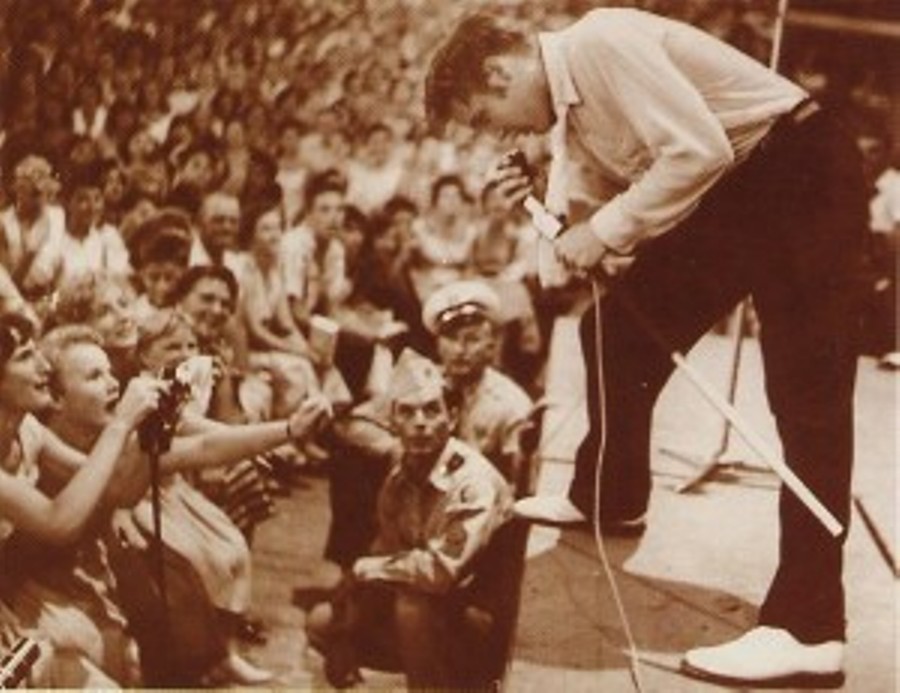
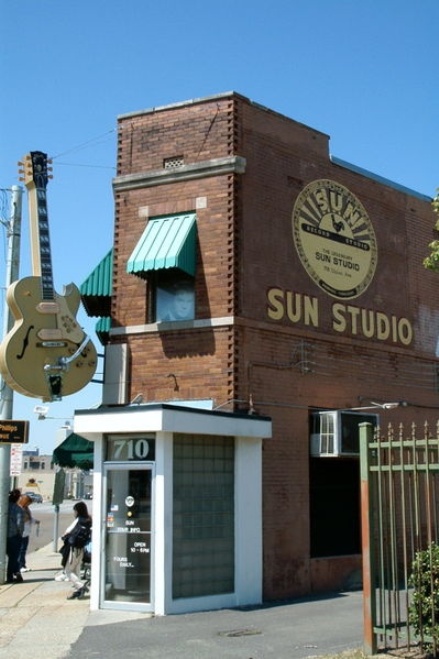
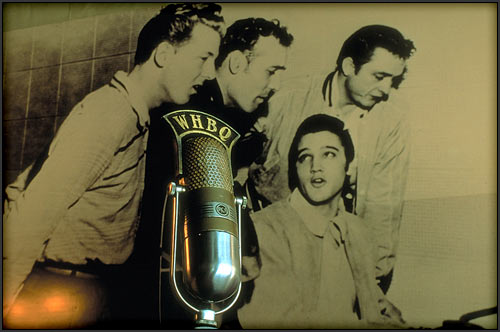
In 1954, Elvis walks into Sun Studio and records the song, ‘My Happiness’ as a gift for his mother. The owner, Sam Phillips, is away so his assistant, Marion Keisker, handles the recording. She saves the tape for Sam to hear. When Sam calls Elvis back, he pairs him with Scotty Moore and Bill Black. Nothing really happens until after a long tedious session on July 4, the trio breaks into a sped-up version of Arthur Crudup’s “That’s All Right”. This song paired with a livened up version of Bill Monroe’s ‘Blue Moon of Kentucky’ would be the first of five singles Elvis would release on the Sun label.

By 1956, Elvis is a sensation. His first million seller is ‘HeartBreak Hotel’.   He performs on The Ed Sullivan Show, among others, and causes quite a controversy over his movement on stage.

1-02-heartbreak-hotel1

.

The Sensational Elvis

elvis-19501

Elvis in 1950

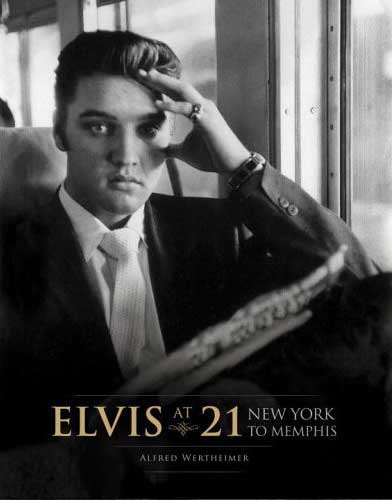
elvis-at-21

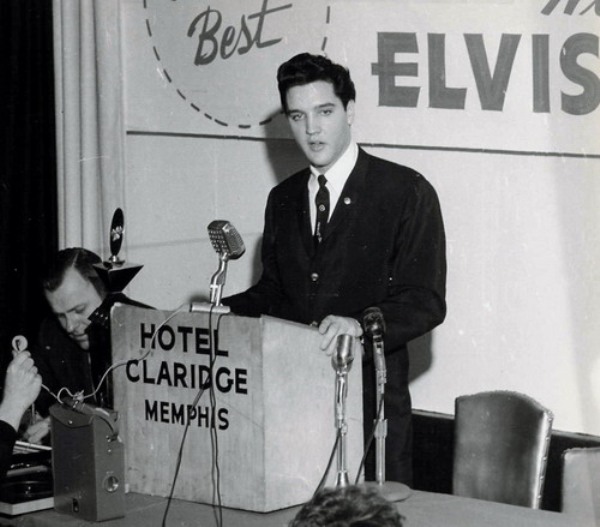
Elvis at the Claridge Hotel in Memphis

Elvis at the Claridge Hotel in Memphis

memphis-sun-studio

Sara’s Scar

Sara was about 8 yrs old.  Her daddy, along with her older brother Johnny, were on the roof repairing some storm damage. They had a brick on the roof with them, for some reason. Down below, Sara was casually walking by when suddenly brother Johhny decided they didn’t need the brick on the roof with them any more and tossed it to the ground (without a thought as to who might be hanging out or walking by below them).  Well…. it happened to be his little sister Sara who happened to be passing by ‘at just that time’ and it struck her ‘in the face’ – on the left eyebrow to be exact, barely missing her eye!

johnny_young-manSweet Brother Johnny (front center)

Because she was taken by surprise with no chance to protect herself, she was ‘knocked out cold.’ Johnny quickly shimmied down the ladder and cradled his limp sister in his arms, yelling “Don’t die, don’t die.”

You can see the scar (in her photo below) which remains visible today.  It is always a reminder for Sara of her older brother, whom she absolutely adores and admires to this day.  Still here…didn’t die.. by the grace of the good Lord above.

sara_scarSara (right) with Bobby Gene Holloway, a cousin.

Memphis Trivia Contest – Just for Fun

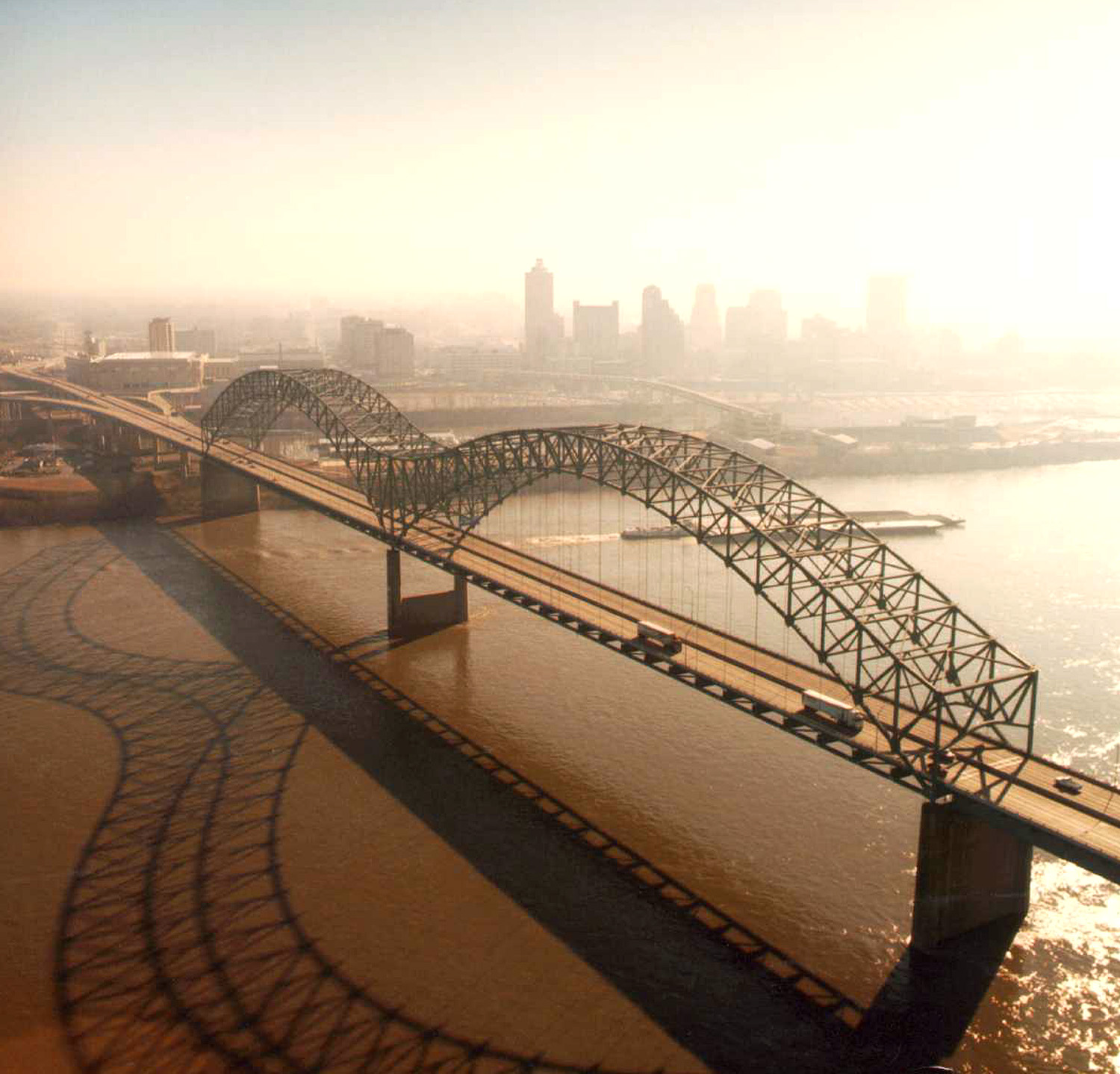
Hernando de Soto Bridge in Memphis, Tennessee

Hernando de Soto Bridge in Memphis, Tennessee

Want to enter the contest officially?

http://www.memphistravel.com/hometown_tourist/trivia.aspx

Geneva and the Cow Birth

On a trip to see Sara and Dave, Sara’s sister Geneva heard that one of her cows was “fixin to (as they say in the south) have a baby calf.” She said, “I want to see it!  I’ve never seen a cow give birth.” So they all loaded up and went to the pasture.  They hid in the bushes… and they waited.  Well, the poor cow was in a great deal of pain and she walked and she whined and she tried for what seemed like forever to have the calf.

cow_black_white

Finally, Geneva had taken all she could take.  She was tortured, seeing this poor cow in agony and just couldn’t help suddenly crying out loud to the cow, “I wish I could help you..press harder.”

cow_mother-and-baby1

Meeting the In-Laws

Sara made a trip with Dave, her fiance, to visit with her “soon-to-be” in-laws before their upcoming marriage.  They all sat down for a good ole country dinner together.  Along with Dave’s parents, his spirited grandmother, Mamaw Rhoda, was there.  They called her “Rodie.” She was a strong pioneer woman, kindhearted with a quick witted very good sense of humor.

rhoda

Mamaw Rhoda “Rodie” Wilson

Although elderly, Rhoda was very able-bodied, lived by herself until she was about 97 years old and kept a nice garden.  Dave was close to his grandmother.  She took care of him throughout his boyhood and he loved spending time with her.  She enjoyed cooking and making hand-pulled taffy which naturally would appeal to a young man.  (Rhoda lived to the ripe old age of 99 years and 7 months.) With Dave’s family living in such a close-knit rural community, it was quite common for them to gather together for dinner just as they did on this occasion.

chicken_hot

The dinner was “fried chicken with all the trimmings.” During the meal Sara noticed that Rhoda was eating quite a bit of chicken, but she wondered, “where were the bones?” Well, she soon found out.  When Dave’s mother, Bessie cleared the plates, there they were “UNDER Sara’s plate.” Being a blushing young bride and somewhat nervous in the company of her new in-laws, she became red faced.  But they knew what Mamaw Rhoda had just done and they all began to laugh, putting Sara to ease.

Chicken Bones 2

biscuit

On another visit Dave’s father, David, discretely slipped a biscuit in Sara’s jacket pocket.

.

As she was leaving, he asked “What is that in your pocket?” When Sara reached in and came out with a biscuit, he said, “Why didn’t you tell me you were still hungry?”


Sara realized then that she was going to have to watch these folks carefully!  They were real kidders and she really liked that about them.


dancing-roasted-chicken


david-luciousDave’s father, David Lucious Wilson

Our Dear Uncle Abe

Nathan had a brother named Abe. No, his name wasn’t Abraham, and he had a hard time in the service convincing them of that.  They just couldn’t accept that it was just “Abe.”  Actually, he was born in a place called Paint Rock, Alabama and given the name of “Raybon Talmage Wright.”  He legally changed his name to just “Abe” and that is how we all knew him.


He was a bread man after service. He wore a uniform much like the one Jackie Gleason wore as a bus driver. He would bring us fresh bread from the bakery: “yum yum.” 


abe

“Abe, sporting the uniform we remember so well.”

Uncle Abe and his brother, Nathan, could never finish their sentences before the other would answer. It was like Birmingham Brown in the movies (loved that routine). We went to a dime store one day to get a toy sword for our youngest son, Brian.  As we came out with the plastic sword we ran into Uncle Abe.  Using a favorite nickname he had for his brother, he said, “Nate, what are you…” and before he could finish his line, daddy said, “Abe, you spoiled my surprise for your Christmas.”  Then they both just broke into a big laugh.  Not to be outdone, Uncle Abe said  “Well, I got you the same thing.”


The Wrights enjoyed each other every time they were together. There was never a time that they met that there wasn’t lots of laughter and happiness from just being together. What a family!

abe_nathan

Abe (center left) and Nathan (center right) were both “sharp dressed men.”


Abe’s paternal grandfather, Ardill, fought in the famous Battle of Chickamauga during the Civil War.


http://en.wikipedia.org/wiki/Battle_of_Chickamauga

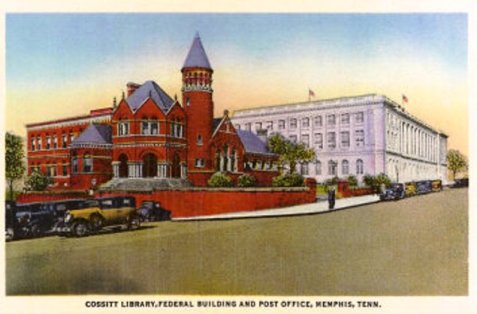
Our Beloved Memphis Cossitt Library

Cossitt Branch Library began its existence as the Cossitt/Goodwyn Institute.

Frederick H. Cossitt, a native of Connecticut, opened a wholesale dry goods business in Memphis. He was very successful and moved on to New York. He kept friends in Memphis and visited often.

He mentioned to Carrington Mason, a business associate, his intention to make a substantial gift for the City of Memphis. It was agreed that a Public Library was needed.

About that time, Mr. Cossitt made a trip to Europe. On this trip, he subsequently became ill and died. He did not mention the gift of a Library in his will. There was only his correspondence and a note stating his intent to give a library to Memphis.

The correspondence and note, of course, were not legally binding. However, his daughters wanted to honor their father’s pledge and plan. Helen Cossitt Julliard, May Cossitt Dodge, and Mr. Thomas Stokes, each gave $25,000 towards the establishment of the new Public Library in Memphis. Mr. Cossitt also left a list of Memphis businessmen of whom he wished to administer the proposed library. On March 8, 1888, the entire $75,000 was delivered to the businessmen and placed in a trust until plans for a public library were completed.

Under the leadership of these select businessmen, a charter was granted by the State of Tennessee on April 6, 1888, under the corporate name of Cossitt Library. It was further decided that the entire $75,000 from the gift should be put into the library building. The City of Memphis promised to furnish “working expenses” for the library and provided a lot overlooking the Mississippi River at the corner of Front Street and Monroe Avenue. Architects were invited to submit designs, and from these Mr. L. B. Wheeler of Atlanta was awarded the contract for the building.

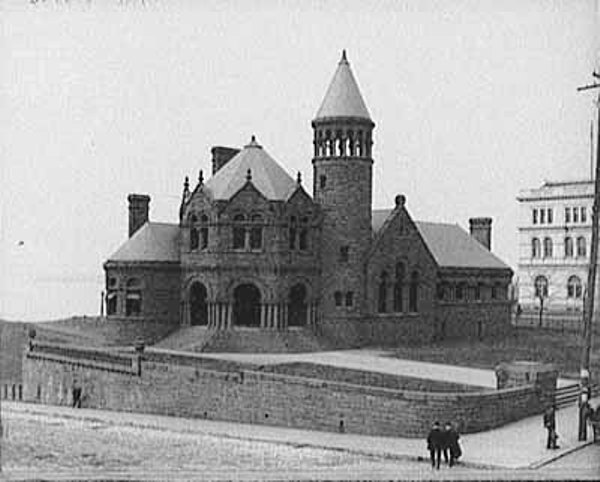
 COSSIT LIBRARY, Memphis, Tennessee (Circa: 1906)cossitt_bwPhoto Courtesy Library of Congress Archives Memphis Tennessee Collectiontn-00106-cccossit-library-memphis-tennessee-postersLINKS:

http://www.memphislibrary.org/

 Frederick H. Cossitt Library

Frederick H. Cossitt was one of our many Cossitt ancestors who were philanthropists.  He is, perhaps, best known for establishing libraries in Granby, Connecticut and Memphis, Tennessee. 

On December 18, 1811, Frederick Henry Cossitt was born in Granby, Connecticut.  He was the great-great grandson of Rene and Ruth Cossitt who had settled in this area a century earlier.  For the most part, he remained in Granby until 1826 when his father died.  At the request of his uncle, George Germain Cossitt, he bid Granby a final farewell and moved Tennessee.  After being engaged in business ventures in several southern states, he moved to Memphis in 1842 where he carried on a successful wholesale dry goods business.  In 1859 he made his final move which was to New York City.  His business ventures in New York City involved real estate, insurance, and banking.

In 1846 he married Catherine Andrus of Hartford and they had three daughters and one son.  The eldest daughter, Helen married Augustus D. Juilliard of New York City.  They had no children and upon their deaths, (Helen 1916, Augustus 1919) they left over 12 million dollars to create the Juilliard Musical Foundation. 

Prior to Frederick H. Cossitt’s death on September 23, 1887, he had orally expressed a desire to build a library in his birth town of Granby as well as Memphis, Tennessee.  Although this desire was never reduced to writing, his heirs honored his desire and gave $10,000 to the town of Granby and $75,000 to start a library in Memphis.

Four years later, on April 12, 1893, the handsome red sandstone building was dedicated. It was Romanesque in style, with rounded wings, towering turrets, and gables. (Cossitt facts excerpted from Mary Davant’s book, Cossitt Library, 1888-1959).

The Tennessee Library Association bestowed its first Literary Landmark status to the branch in 1998, and honored it with a plaque.

The plaque reads as follows:
Friends of Libraries USALiterary Landmarks Register
Cossitt Library,  33 South Front
In the 1920s Richard Wright (1908-1960) was denied access to the library because of race. A sympathetic white man helped Wright use the library, thus nourishing his dream of becoming a writer. This story is told in Wright’s famous autobiography, Black Boy Tennessee Library Association.  April 15, 1998

Read more about the history and development of the Cossitt Library! Materials can be found in the History Department’s Memphis Room located at the Central Library. For more information, call 415-2742.

Messick High School History

Click link below to listen to:
02-mack-the-knife
.
sara_schoolpicsm2
.
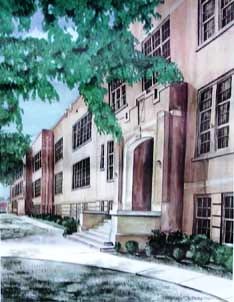
THE FIRST CONSOLIDATED SCHOOL IN SHELBY COUNTY, was organized in 1908, and composed of the elementary schools of Buntyn, Fleece Station, and Avlon. It was named for the Superintendent of County Schools, Miss Elizabeth Messick, now Mrs. Elizabeth Messick Houck.

The First Principal was Miss Daisy Porter, who served for one year. She was followed by Miss Rubie Batte, who gave fourteen Years to building Messick into the fine school it is today. She left to become County Supervisor. Her place was filled by Miss Nina C. Rickman, who served one year.

messick3

In 1923, Mr. Ernest C. Ball , now Superintendent of Memphis City Schools, was made principal and stayed with us until 1928. Under Him Messick grew in importance, being accredited by the Southern Association of College and Secondary Schools, and the State Department of Education. When Mr. Ball left, in mid-term of 1928, Mr. Elliott, finished the school year. He was followed by Miss Fletcher, who held office for one year.

So many fond memories….


berrettas

first-date

In 1930, concurrent with Messick’s change of status from county school to city high school, Mr. T. H. Grinter, coming from Lennox, took over, and has held the chief’s post here for seventeen years, longer than any other principal. He is assisted by Miss Anne Hunt, one of Messick’s mentors since 1918, having served under six principals. Chiefly due to these two, Messick has become what it is today. And if you don’t think Messick is a great school, just ask anyone who goes there.

messick-logo1messick-pic1(Copied from 1948 Messick Annual and www.MessickHigh.org)

« Older entries Newer entries »